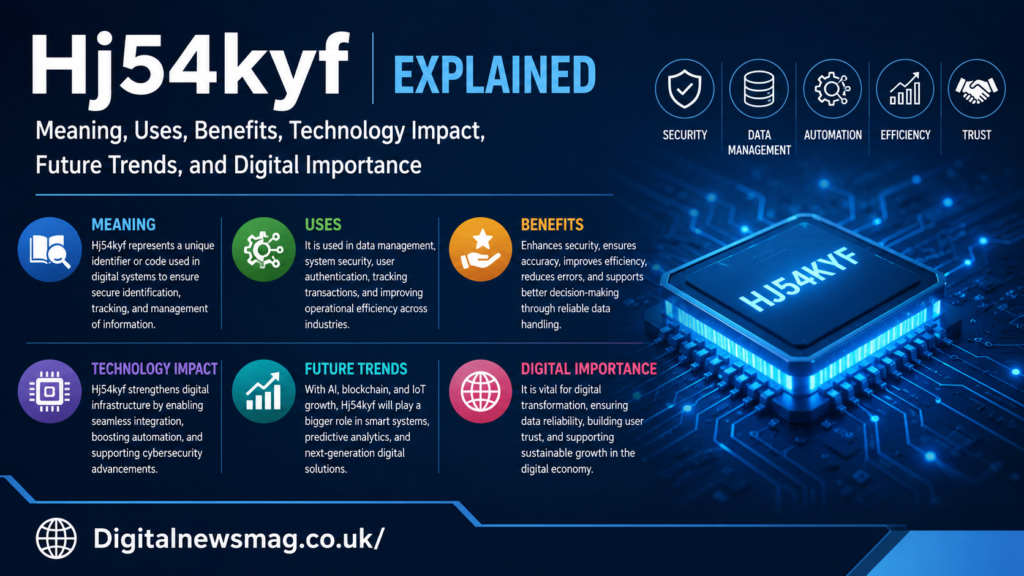

Introduction to Hj54kyf in the Digital World
In today’s digital environment, strange-looking strings like Hj54kyf often appear across websites, databases, and system logs. At first glance, it may look meaningless or randomly typed, but in modern technology systems, such identifiers are extremely common and serve important technical purposes. Understanding them helps users and developers better interpret how digital infrastructure actually works behind the scenes.
Hj54kyf represents a broader category of system-generated identifiers used in software, cloud platforms, and data-driven applications. These identifiers are not meant for human interpretation but for machine-level efficiency. As digital ecosystems grow more complex, such codes play a crucial role in keeping systems organized, scalable, and secure.
This article explores Hj54kyf in detail, breaking down its meaning, usage, importance, and future relevance in technology. By the end, you will understand why such seemingly random strings are essential in modern computing.
What is Hj54kyf?
Hj54kyf is best understood as a system-generated alphanumeric identifier. It does not have a dictionary meaning or cultural definition. Instead, it is produced by algorithms within software systems to uniquely identify an object, record, session, or process.
Such identifiers are widely used in digital systems where large amounts of data need to be managed efficiently. Instead of naming each entry manually, systems automatically generate strings like Hj54kyf to ensure uniqueness and avoid duplication.
These identifiers often appear in URLs, backend databases, API responses, or tracking systems. While users may never interact with them directly, they are essential for keeping digital environments structured and functional.
In short, Hj54kyf is not a “thing” in the traditional sense—it is a functional label used by machines to organize and track information reliably.
Meaning and Interpretation of Hj54kyf
The meaning of Hj54kyf depends entirely on context. On its own, it does not carry any semantic or linguistic meaning. However, within a system, it can represent a specific data entry, user session, or digital object.
Developers and engineers often interpret such identifiers based on where they appear. For example, in a database, Hj54kyf might represent a product record. In a web application, it could be a session token assigned to a user.
This context-driven interpretation is a key principle in software design. Machines rely on structure, not language, which is why random-looking identifiers are actually very powerful tools in computing.
Ultimately, Hj54kyf is meaningful only within the system that created it, making it a contextual identifier rather than a universal term.
Common Uses of Hj54kyf in Technology
System-generated identifiers like Hj54kyf are used in many areas of modern computing. One of the most common uses is data tracking. Large platforms need a way to distinguish between millions or even billions of records, and unique IDs make this possible.
Another important use is in backend development. Databases rely heavily on unique identifiers to store, retrieve, and update information efficiently. Without these, data collisions and errors would be common.
Hj54kyf-like strings are also used in session management. When a user logs into a website, the system may assign a temporary ID to track their activity securely without exposing personal information.
Additionally, APIs often use such identifiers to manage requests and responses between systems. This ensures smooth communication between different software components.
Benefits of System-Generated Identifiers Like Hj54kyf
One of the biggest benefits of identifiers like Hj54kyf is uniqueness. Each generated string is typically designed to be one-of-a-kind, preventing conflicts in large systems where millions of entries exist.
They also improve efficiency. Instead of relying on human-readable labels, systems can process compact, standardized identifiers much faster. This makes databases and applications more responsive.
Another advantage is scalability. As systems grow, manually managing identifiers becomes impossible. Automated generation ensures that expansion does not break structure or performance.
Finally, these identifiers support automation. Machines can easily generate, read, and process them without human intervention, reducing errors and improving reliability across digital platforms.
How Hj54kyf Works in Digital Systems
Hj54kyf-style identifiers are typically generated using algorithms that ensure randomness or uniqueness. These may include hashing functions, random string generators, or UUID-based systems.
When a new record or object is created, the system automatically assigns a unique identifier. This ensures that every entry can be individually accessed without confusion.
Behind the scenes, the system checks for duplication and ensures that no two identifiers are identical. This process happens in milliseconds, making it seamless for users.
Once generated, the identifier is stored alongside the data it represents. Whenever the system needs to retrieve or modify that data, it uses the identifier as a reference point.
Importance of Hj54kyf in Modern Technology
In modern digital infrastructure, identifiers like Hj54kyf are essential for maintaining order and efficiency. They are especially important in large-scale systems such as cloud computing platforms, e-commerce websites, and social media networks.
These identifiers help ensure data integrity by preventing overlap and confusion between records. Without them, managing large datasets would become nearly impossible.
They also play a role in cybersecurity. By using non-guessable identifiers, systems can reduce the risk of unauthorized access or data manipulation.
Overall, Hj54kyf represents a fundamental building block in the architecture of modern digital systems.
Challenges and Limitations of Hj54kyf-Type Identifiers
Despite their usefulness, system-generated identifiers like Hj54kyf come with some challenges. One major limitation is that they are not human-friendly. People cannot easily remember or interpret them.
This can create difficulties in debugging or manual system analysis, especially for developers working directly with raw data. Searching through logs filled with such identifiers can be time-consuming.
Another challenge is lack of transparency. Since these identifiers do not carry meaning, users may find them confusing when they appear in URLs or error messages.
However, these limitations are generally outweighed by their technical benefits, which is why they remain widely used.
Future of System-Generated Identifiers Like Hj54kyf
As technology evolves, identifiers like Hj54kyf will continue to play a key role in digital systems. However, their design and usage may become more advanced and structured.
Future systems may integrate AI to generate smarter identifiers that carry contextual metadata while still maintaining uniqueness. This could improve both machine efficiency and human understanding.
Blockchain and decentralized systems may also influence how identifiers are created and managed, adding layers of transparency and traceability.
Despite these advancements, the core concept of unique system-generated identifiers will remain essential in technology ecosystems.
Real-World Examples Similar to Hj54kyf
Hj54kyf is similar to many real-world identifiers used in everyday technology. One common example is a UUID (Universally Unique Identifier), which is used in software systems to label data uniquely.
Another example is session IDs used by websites to track user activity during login sessions. These are temporary but function similarly to Hj54kyf.
API keys also follow the same principle, allowing secure communication between applications. Even tracking numbers in logistics systems rely on similar identifier structures.
These examples show that Hj54kyf is part of a much larger ecosystem of digital identification systems used across industries.
Conclusion
Hj54kyf may appear meaningless at first, but it represents an essential concept in modern computing: system-generated identifiers. These identifiers ensure that digital systems remain organized, scalable, and secure.
From databases to APIs, they form the backbone of how information is stored and retrieved in today’s technology-driven world. While they may not be human-readable, their importance cannot be overstated.
Understanding concepts like Hj54kyf helps demystify how digital systems operate behind the scenes. As technology continues to evolve, such identifiers will remain a core part of the infrastructure powering the digital world.
FAQs About Hj54kyf
What is Hj54kyf used for?
Hj54kyf is used as a system-generated identifier in digital environments. It helps label and track data uniquely within databases, applications, and backend systems without requiring human-readable names.
Does Hj54kyf have a real meaning?
No, Hj54kyf does not have a fixed linguistic or dictionary meaning. Its value comes from the system that generates and uses it rather than from language or context outside technology.
Why do systems use identifiers like Hj54kyf?
Systems use such identifiers to ensure uniqueness, prevent data duplication, and improve efficiency in managing large volumes of digital information automatically.
Is Hj54kyf safe or dangerous?
Hj54kyf itself is neither safe nor dangerous. It is simply a technical identifier used by systems. Its safety depends entirely on how the system using it is designed and secured.
Can humans read or understand Hj54kyf easily?
While humans can read it, Hj54kyf is not designed for interpretation. It is meant for machines, which is why it appears random and lacks intuitive meaning.